

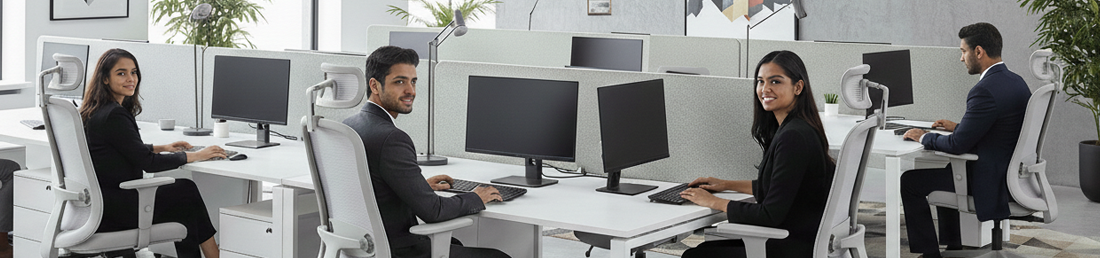
When you sit for hours, the difference becomes everything.
At a glance, an Office chair and an Ergonomic chair may look similar. Both support your weight. Both fit beneath a desk. Both are designed for work.
But similarity in appearance does not mean similarity in purpose.
The true difference reveals itself not in the first five minutes of sitting, but in the fifth hour. In the subtle fatigue across your shoulders. In the quiet ache of your lower back. In your ability, or inability, to stay focused without shifting constantly.
Understanding the distinction between an Office chair and an Ergonomic chair is not about preference. It is about posture, performance, and long-term well-being.
At Bezomè, we believe seating is not furniture alone. It is the infrastructure for how you live and work.
What Is a Traditional Office Chair?
An Office chair is broadly defined as a chair designed for desk work. It typically includes:
- A fixed or minimally adjustable backrest
- Basic seat height adjustment
- Armrests, sometimes non-adjustable
- A swivel base with casters
While modern Office chairs may offer modest cushioning and aesthetic appeal, many prioritize affordability and general use over anatomical precision.
This does not mean all Office chairs are poorly made. However, their design often assumes a standard body type and a static sitting posture. They may lack features that support spinal alignment, dynamic movement, and personalized adjustments.
For short tasks or occasional desk use, a standard Office chair may feel sufficient.
For long hours of focused work, it may not.
What Defines an Ergonomic Chair?
An Ergonomic chair is engineered specifically to support the natural mechanics of the human body during prolonged sitting.
The word “ergonomic” refers to designing products that optimize human well-being and overall system performance. In seating, this translates to adjustability, alignment, and movement.
A well-designed Ergonomic chair typically includes:
- Adjustable lumbar support to maintain the spine’s natural curve
- Seat height and depth adjustments
- Recline mechanisms with tension control
- Adjustable armrests in height and width
- A contoured backrest that supports spinal alignment
- Breathable materials for temperature regulation
Unlike a standard Office chair, an Ergonomic chair adapts to your body’s proportions and movement patterns.
The goal is not simply to provide a place to sit, but to reduce musculoskeletal strain, improve posture, and enhance comfort during extended periods of work.
The Structural Difference: Support vs. Surface Comfort
The most important difference between an Office chair and an Ergonomic chair lies beneath the surface.
A standard Office chair often focuses on cushioning. Soft padding may feel comfortable initially. However, without proper lumbar support and adjustability, that comfort can quickly translate into slouched posture.
An Ergonomic chair focuses on structural support.
The spine has a natural S-shaped curve. Prolonged sitting tends to flatten the lower back, leading to increased pressure on spinal discs and surrounding muscles. Over time, this can contribute to lower back pain, neck strain, and fatigue.
By maintaining lumbar support and encouraging neutral alignment, an Ergonomic chair helps:
- Distribute body weight evenly
- Reduce pressure on the lower back
- Minimize strain on shoulders and neck
- Improve blood circulation in the legs
The result is sustained comfort, not temporary softness.
Adjustability: Personalization Matters
No two bodies are identical.
A major limitation of many Office chairs is limited adjustability. Fixed armrests may force your shoulders upward. Inadequate seat depth may compress the back of your knees. A non-adjustable backrest may not align with your lumbar curve.
An Ergonomic chair recognizes variability.
Adjustability allows you to tailor:
- Seat height so your feet rest flat on the floor
- Seat depth to maintain two to three inches between the seat edge and the back of your knees
- Lumbar position to match your spinal curve
- Armrest height so shoulders remain relaxed
- Recline angle to encourage dynamic sitting
This level of customization is essential for long workdays, whether in a corporate setting or a home office.
Bezomè chairs are designed with evolving versatility in mind. Our approach to the Ergonomic chair integrates precision engineering with refined design, ensuring that functionality feels seamless rather than mechanical.
Because true support should feel intuitive.
Movement vs. Static Sitting
Another key difference lies in movement.
Traditional Office chairs often encourage static sitting. Once adjusted, they remain fixed. Yet research in occupational health consistently shows that prolonged static posture increases fatigue and discomfort.
The human body thrives on micro-movements.
A high-quality Ergonomic chair incorporates dynamic recline systems that allow gentle shifts in posture throughout the day. These subtle movements:
- Reduce pressure on spinal discs
- Improve circulation
- Prevent stiffness in hips and lower back
- Support sustained focus
Dynamic sitting does not mean constant motion. It means your chair moves with you, rather than against you.
This responsiveness is what transforms seating into a long-term wellness investment.
Productivity and Cognitive Impact
The difference between an Office chair and an Ergonomic chair is not only physical. It is cognitive.
Discomfort distracts.
When your lower back aches or your shoulders tighten, attention shifts from the task at hand to physical irritation. Over time, this reduces deep work capacity and increases mental fatigue.
Studies in workplace ergonomics have shown that improved seating support correlates with higher productivity and reduced absenteeism related to musculoskeletal issues.
An Ergonomic chair supports focus indirectly by reducing physical strain. When your body feels stable and aligned, your mind is free to concentrate.
This is particularly important in modern hybrid work environments, where home offices often lack professional ergonomic setups.
Choosing an Ergonomic chair is not indulgence. It is preventive care.
Long-Term Health Considerations
Musculoskeletal disorders remain one of the leading causes of work-related health concerns globally. Prolonged poor posture contributes to chronic back pain, repetitive strain injuries, and neck tension.
While an Office chair may suffice for short-term use, an Ergonomic chair is designed for longevity.
Features such as certified structural integrity, durable materials, and environmentally responsible construction ensure that comfort does not compromise health.
Bezomè chairs align with recognized industry standards such as BIFMA compliance and GreenGuard certification. This means structural reliability and safer indoor air quality, especially important in enclosed home office environments.
Your chair influences more than comfort. It influences how you feel at the end of each day.
Aesthetic vs. Alignment: Why You Should Not Have to Choose
Many assume that choosing an Ergonomic chair means sacrificing design.
At Bezomè, we reject that compromise.
We believe an Office chair should complement your space, and an Ergonomic chair should support your body. The difference lies not in visual appeal, but in engineering intention.
A well-designed Ergonomic chair integrates breathable materials, sculpted forms, and quiet adjustability into a cohesive experience.
It is where craftsmanship meets conscious living.
So, What Truly Makes the Difference?
An Office chair offers a place to sit.
An Ergonomic chair offers a system of support.
One prioritizes general use.
The other prioritizes alignment, adjustability, and long-term well-being.
If you work for hours each day, the difference is not subtle. It is structural.
When posture is supported, energy lasts longer.
When movement is encouraged, stiffness decreases.
When your body feels aligned, your mind follows.
Choosing an Ergonomic chair is not about trend or terminology. It is about respecting the hours you spend building your life.
Because the way you sit shapes the way you work.
And the way you work shapes the way you live.


